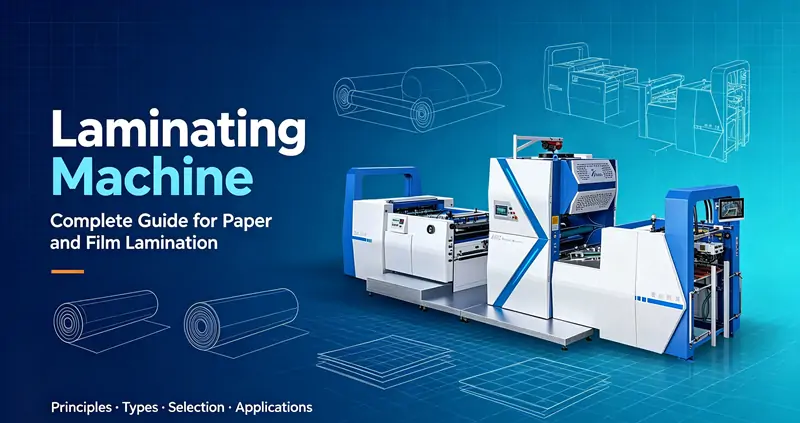
What Is a Laminating Machine?
A laminating machine is a piece of printing and packaging equipment that bonds a plastic film layer—such as BOPP, PET, or PVC—onto paper, cardboard, or other substrate materials. The purpose is to enhance the printed material's durability, water resistance, appearance, and overall shelf appeal. From book covers and food packaging to luxury gift boxes and labels, laminated products are everywhere in daily life.
The laminating process serves both functional and aesthetic purposes. Functionally, lamination protects printed surfaces from moisture, scuffing, and wear during handling and transportation. Aesthetically, it adds gloss or matte finish, improves colour depth, and gives products a premium feel that can command higher retail prices.
At its core, a laminating machine applies heat, pressure, or adhesive—depending on the technology—to fuse a film layer to a substrate. The result is a single, unified sheet that combines the print quality of paper with the protective properties of plastic film.
For printing and packaging companies, selecting the right laminating machine is a strategic decision that affects production efficiency, product quality, and operating costs. This guide covers everything from basic principles to machine types, application scenarios, and selection criteria.
How Does a Laminating Machine Work?
While different types of laminating machines operate through distinct mechanisms, the fundamental principle remains consistent: film + substrate + adhesive (or heat) + pressure = laminated product.
The Basic Lamination Process
- Film Unwinding – The laminating film, which may be pre-coated with adhesive (thermal film) or uncoated (requiring water-based or oil-based adhesive application), is fed into the machine.
- Adhesive Application – For water-based or oil-based systems, a glue coating unit applies adhesive to either the film or the paper surface. For thermal systems, the adhesive is already present on the film and only requires heat activation.
- Feeding – Paper or board sheets are fed into the machine—either manually (semi-automatic) or automatically via a sheet feeder (fully automatic).
- Lamination – The film and paper are brought together under a heated or cold roller system. Heat activates the adhesive in thermal systems, while pressure alone bonds the layers in cold lamination with water-based adhesive.
- Cutting/Slitting – After lamination, the continuous film is cut between sheets using various cutting systems—disc cutter, chain knife, or hot knife—depending on the film type.
- Stacking – The finished sheets are automatically stacked for collection.
The Role of Heat and Pressure
Temperature and pressure are the two critical variables in lamination. Heat activates adhesives and softens films to conform to the paper surface. Pressure ensures complete contact between the film and substrate, eliminating air bubbles and achieving a strong bond.
Different film types require different temperature settings. BOPP film typically laminates at 80–100°C, while PET film, with its higher melting point and lower thermal conductivity, requires 100–120°C. Achieving precise temperature control—within ±1°C—is essential for consistent results.
AOLI's laminating machines feature advanced electromagnetic heating technology that reaches working temperature in just 3 minutes with ±1°C accuracy, offering significant energy savings compared to traditional oil heating systems.
Types of Laminating Machines
Laminating machines can be classified by structure, heating method, or feeding method. AOLI offers four main types of laminating machines, each designed for specific production requirements, film types, and business scales.
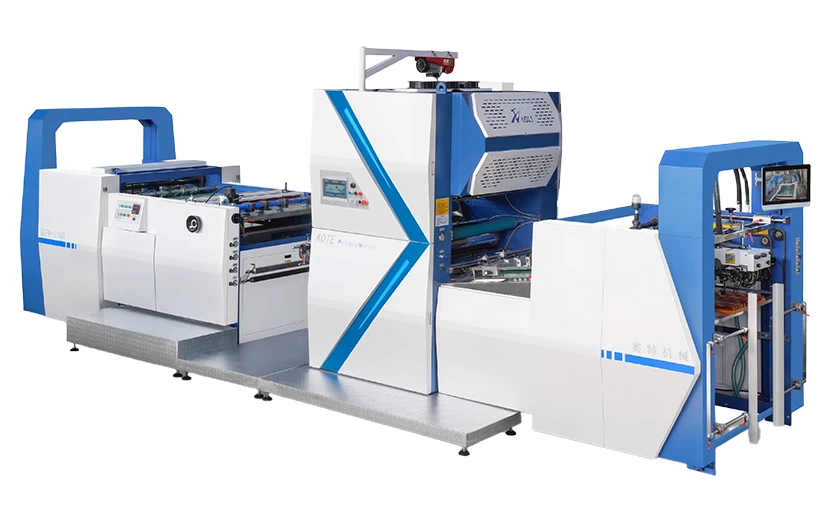
1. Vertical Laminating Machine
The vertical laminating machine is the most versatile configuration, compatible with water-based, oil-based, and thermal film processes. Its vertical structure allows for a compact footprint while accommodating a wide range of paper sizes and thicknesses.
Key Models in the QLFM-1100 Series:
| Model |
Cutting System |
Best Suited For |
| QLFM-1100A |
Disc Cutter |
BOPP and OPP film applications |
| QLFM-1100B |
Chain Knife |
BOPP, OPP, PVC, PET, metalized films |
| QLFM-1100C |
Chain Knife + Embossing |
Premium printing and packaging with embossing |
| QLFM-1100D |
Hot Knife |
PET, PVC, metalized films and specialty materials |
The SLFM-1100 semi-automatic model is also available as a cost-effective solution for commercial printing operations.
All automatic vertical laminating machines support speeds up to 100 m/min, paper thickness from 100–500 gsm, and maximum paper sizes up to 1080×1000 mm.
Key Advantages:
- Three-in-One Compatibility – Works with water-based adhesives, oil-based adhesives, and pre-coated films.
- Electromagnetic Heating – Reaches working temperature in just 3 minutes with ±1°C accuracy.
- Multiple Cutting Options – Disc cutter for standard films, chain knife for PET and metalized films, and hot knife for specialty materials.
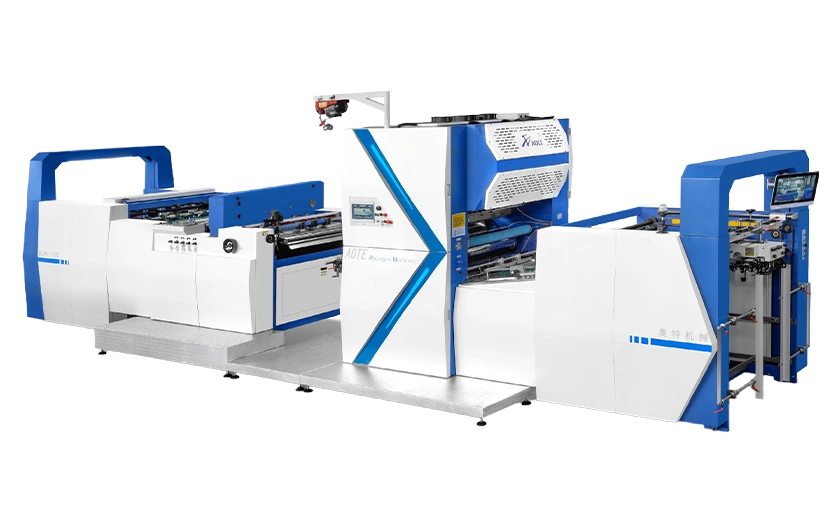
2. Thermal Laminating Machine
The thermal laminating machine is designed specifically for pre-coated (thermal) films. Unlike water-based systems, thermal lamination requires no glue mixing, no glue cleaning, and no drying time. The adhesive is already applied to the film during manufacturing; the machine simply applies heat and pressure to activate it.
Key Models:
| Model |
Cutting System |
Key Feature |
| ZWFM-1100A |
Disc Cutter |
BOPP and standard thermal films |
| ZWFM-1100B |
Chain Knife |
BOPP, PET, PVC, specialty thermal films |
| SF-720/920/1100 |
Semi-Automatic |
Economical solution for BOPP thermal film |
Key Advantages:
- No Adhesive Handling – Eliminates glue mixing, cleaning, and related labour costs.
- Clean Operation – No adhesive residue on rollers means less maintenance and cleaner working environment.
- Fast Changeover – Electromagnetic heating reaches working temperature in 3 minutes, making it ideal for short runs and frequent job changes.
Thermal laminating machines work with BOPP, CPP, PET, and metalized thermal films, with paper stocks from 100–500 gsm.
3. Water-Based Cold Laminating Machine
The water-based cold laminating machine uses water-based adhesive that does not require heating during the lamination process. This significantly reduces energy costs compared to thermal lamination.
Key Models:
| Model |
Automation Level |
Key Feature |
| SZFM-1200 |
Automatic |
Automatic feeding, uniform glue coating, stable rewinding |
| SFM-750/1000/1200 |
Manual |
Cost-effective for smaller operations |
| CSFM-1000/1200 |
Manual |
Dual glue coating for window laminating |
Key Advantages:
- Energy Efficient – No heating required during lamination, significantly lowering operating costs.
- Anti-Crease for Thin Paper – Thin paper flattening mechanism and corrugated delivery system prevent bending and wrinkling, especially for paper down to 100 gsm.
- Low Maintenance – Simple mechanical design with fewer parts to replace.
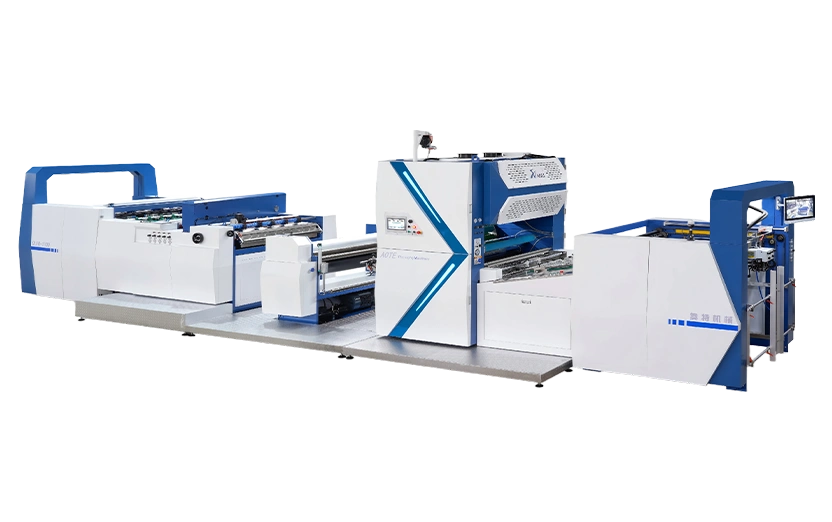
4. Roll-to-Roll Laminating Machine
The roll-to-roll laminating machine is designed for continuous, high-volume production. Instead of feeding individual sheets, the machine processes roll-fed materials in a continuous web, dramatically increasing throughput for large orders.
Key Model: JTFM-1100 Automatic Roll-to-Roll Laminating Machine
| Specification |
Value |
| Max Speed |
100 m/min |
| Max Web Width |
Up to 2300 mm |
| Paper Thickness |
100–500 gsm |
| Control System |
PLC + Touch Screen |
| Rewinding Diameter |
Up to 1400 mm |
Key Advantages:
- Continuous Production – Non-stop operation eliminates sheet-by-sheet feeding, ideal for high-volume orders.
- Automatic Edge Correction – CCD visual sensor and edge deviation controller ensure precise alignment during unwinding and rewinding.
- Variable Frequency Drive – Smooth, energy-efficient speed control.
Auxiliary Equipment
In addition to core laminating machines, AOLI offers supporting equipment that completes the production line:
- Powder Remover – Removes spray powder from printed sheets before lamination, preventing adhesive failure and surface defects.
- Sheet Separator – Precisely separates laminated sheets for accurate stacking.
- Stacker – Automates sheet collection, reducing manual labour and improving efficiency.
- Embossing Unit – Adds textured patterns to laminated surfaces for premium finishes.
Laminating Machine Applications
Laminating machines serve a wide range of industries and applications. The choice of machine type, film, and adhesive system depends on the specific requirements of each application.
Packaging
Packaging is the largest application segment for laminating machines. Laminated packaging offers superior print protection, moisture resistance, and shelf appeal.
Common Packaging Applications:
- Food Packaging – Thermal lamination is widely used for food packaging where glue-free, food-safe lamination is required.
- Luxury and Gift Packaging – Premium boxes and gift packaging benefit from the gloss and durability of laminated finishes.
- Shopping Bags – Water-based cold lamination provides a cost-effective solution for retail bags.
AOLI has successfully supplied laminating machines to a Brazilian gift packaging company with over 30 years of experience. The operation laminates glossy and matte BOPP, PET, and metalized films onto cardboard, handling sheet sizes up to 720×1020mm and paper weights from 115–350gsm.
Printing
Commercial printing is another major application area. Laminated prints are more durable, water-resistant, and visually appealing.
Common Printing Applications:
- Book Covers – Lamination protects book covers from wear and enhances colour reproduction.
- Posters and Brochures – Large-format printed materials benefit from the protective and aesthetic properties of lamination.
- Catalogues and Magazines – Lamination adds durability to frequently handled publications.
Labels and Stickers
The label industry relies heavily on lamination to provide durability and a premium feel.
Common Label Applications:
- Product Labels – Lamination protects labels from moisture, rubbing, and fading.
- Specialty Labels – Metalized film lamination creates a reflective, high-end appearance.
Other Applications
- Maps and Technical Documents – Lamination adds durability to frequently handled documents.
- Photography – Lamination protects photographic prints from fingerprints and environmental damage.
- Menus and Placemats – Restaurants and hospitality venues use laminated products for durability and easy cleaning.
How to Choose a Laminating Machine
Selecting the right laminating machine requires careful evaluation of several factors. Here is a step-by-step approach to making the right decision.
Step 1: Identify Your Primary Applications
Consider the types of products you will be laminating, including the substrate material, size, and thickness. If you handle a wide variety of jobs, the vertical laminating machine's three-in-one compatibility offers maximum flexibility. If you specialize in a specific application, a dedicated thermal or water-based machine may be more cost-effective.
Step 2: Determine Your Production Volume
For lower production volumes, a manual or semi-automatic model may be adequate. For medium to high volumes, an automatic laminating machine with sheet feeder and automatic stacking significantly improves efficiency. For the highest volumes, a roll-to-roll machine provides continuous, high-speed operation.
Step 3: Assess Your Labour Force
Fully automatic laminating machines require less manual intervention and reduce labour costs. However, they require initial investment and operator training. Semi-automatic machines may be a better fit for smaller operations or companies transitioning from manual processes.
Step 4: Consider Your Film and Adhesive Requirements
Different film types require different machine configurations and cutting systems:
- BOPP (with water-based or oil-based adhesive) → Disc cutter
- PET, PVC, metalized films → Chain knife
- Thermal/pre-coated films → Hot knife or disc cutter
Step 5: Plan Your Production Line Integration
Consider how the laminating machine will integrate with your existing production line. Auxiliary equipment such as powder removers, sheet separators, and stackers may be needed. A complete production line solution reduces workflow interruptions and improves overall efficiency.
Step 6: Evaluate Energy Consumption and Operating Costs
Energy costs can be a significant part of operating expenses. Electromagnetic heating technology reduces energy consumption, and water-based cold lamination eliminates heating costs. Consider both the initial purchase price and long-term operating costs.
Step 7: Check After-Sales Support and Global Service
AOLI maintains a global after-sales service network with a 48-hour rapid response commitment for urgent issues. The company operates a global spare parts warehouse for real-time inventory checking and fast delivery, minimizing production downtime.
AOLI Laminating Machine Solutions
AOLI (Ruian AOLI Packaging Machinery Co., Ltd.) is a professional printing equipment manufacturer established in the early 2000s and located in Ruian Economic Development Zone. The company holds ISO 9001 quality management system certification and CE safety certification, with over 12 valid patents.
AOLI's products are exported to 34 countries, serving a wide range of printing and packaging customers. The company's global service network includes more than 8 after-sales engineers who provide technical support worldwide.
Why AOLI Laminating Machines?
- Electromagnetic Heating Technology – Reaches working temperature in 3 minutes with ±1°C accuracy.
- Three-in-One Compatibility – Water-based, oil-based, and pre-coated film capability in one machine.
- Smart Control System – PLC control, touchscreen HMI, and automatic fault diagnosis.
- Precision Manufacturing – Integrated steel frame body with imported core components.
- Global Service – 48-hour rapid response and worldwide spare parts availability.
- Proven Track Record – Serving customers in 34 countries with over 12 patents.
Frequently Asked Questions
What is the difference between thermal and water-based lamination?
Thermal lamination uses pre-coated film with heat activation and requires no glue handling. Water-based lamination uses water-based adhesive at room temperature and consumes less energy but requires glue mixing and cleaning. The choice depends on your production requirements, energy costs, and film types.
How do I choose between automatic and semi-automatic laminating machines?
Automatic machines are suitable for medium to high-volume production, reducing labour costs and improving speed. Semi-automatic machines are more affordable and suitable for smaller operations or companies transitioning from manual processes.
Which film types can a vertical laminating machine handle?
AOLI's vertical laminating machines work with BOPP, OPP, PVC, PET, and metalized films, with water-based, oil-based, or pre-coated adhesives.
What is electromagnetic heating and why does it matter?
Electromagnetic heating is a technology that directly heats the lamination roller using electromagnetic induction. It reaches working temperature in 3 minutes, provides ±1°C accuracy, and saves energy compared to traditional oil heating systems.
How do I maintain my laminating machine?
Regular maintenance includes daily cleaning of rollers, weekly inspection of heating systems and pressure settings, and monthly checks of electrical components and lubricant levels. Refer to the machine manual for specific maintenance schedules.
Does AOLI provide global service and support?
Yes. AOLI provides a 48-hour rapid response service for urgent issues, with a global spare parts warehouse for quick delivery. The company has more than 8 after-sales engineers supporting customers worldwide.
Where can I find more information about AOLI's laminating solutions?
You can browse the full
product range or contact the team directly for application-specific advice.
Conclusion
Choosing the right laminating machine is a decision that affects your production efficiency, product quality, and operating costs. Understanding the basic principles, available machine types, and application requirements is the foundation for making the right choice.
AOLI offers a comprehensive range of laminating machines for different business scales and application needs—from the versatile vertical laminating machine to dedicated thermal and water-based systems, as well as high-volume roll-to-roll solutions. With global service support, advanced electromagnetic heating technology, and a proven track record across 34 countries, AOLI provides a reliable equipment solution for printing and packaging companies worldwide.
For a complete overview of available laminating machine configurations, visit the products overview page. If you have specific questions about your production needs, the contact page provides direct access to technical support.
Disclaimer: The temperature, pressure, and speed values provided in this article are general industry reference ranges based on publicly available material science and printing industry knowledge. They are not performance guarantees or exclusive data from AOLI. Actual optimal settings depend on the specific film brand, substrate type, adhesive system, and equipment configuration. Always run sample tests before full production. For AOLI-specific product specifications, certifications, service commitments, and customer case details, please refer to the official AOLI website.

 Aug 18,2026